Contents
Scroll to:
https://doi.org/10.37489/2588-0527-0014
EDN: OSWOLZ
Scroll to:
Background. The prevalence of clopidogrel resistance among patients with cardiovascular diseases (CVD) reaches 30–40 %, significantly increasing the risk of recurrent myocardial infarction (MI) and other thrombotic events. Genetic polymorphisms in CYP2C19 and ABCB1 account for up to 40 % of the variability in antiplatelet response; however, data on Turkic populations, including the Chuvash, remain fragmentary.
Objective. To determine the frequencies of CYP2C19 (*2, *3, *17) and ABCB1 C3435T polymorphisms, as well as their association with recurrent MI and clopidogrel resistance in patients of Chuvash ethnic origin with CVD, including acute coronary syndrome (ACS).
Materials and methods. This prospective cohort study included 216 Chuvash patients (mean age 66.5 years) with CVD, including ACS, receiving dual antiplatelet therapy with clopidogrel. Genotyping of CYP2C19 (*2, *3, *17) and ABCB1 (3435C>T) polymorphisms was performed using real-time PCR. In a subgroup of ACS patients (n=30), ADP-induced platelet aGGreGAtion was assessed turbidimetrically on day 7 of therapy.
Results. Among Chuvash patients, a high frequency of minor alleles was observed: ABCB1 C3435T — 60.6 %, CYP2C1917 (–806C>T) — 28.7 %, whereas the frequencies of CYP2C192 and CYP2C193 were low (9.05 % and 1.85 %, respectively). Heterozygous CT genotype of CYP2C19*17 was associated with a higher rate of recurrent MI both in the overall cohort (19.8 % vs. 8.5 % in CC carriers; p=0.049) and in the ACS subgroup (30.2 % vs. 12.9 %; p=0.037, p~CC–CT~ =0.044). Laboratory platelet aGGreGAtion assessment revealed that the highest proportion of antiplateletresistant patients was observed among heterozygotes carrying the *1/*17 genotype (rapid metabolizer phenotype), whereas no resistance cases were recorded among *17/*17 homozygotes (ultrarapid metabolizers). No statistically significant associations with recurrent MI were found for CYP2C192, CYP2C193, or ABCB1 polymorphisms.
Conclusion. In Chuvash patients with CVD, including ACS, heterozygous carriage of CYP2C1917 is associated with recurrent MI, which contradicts the expected enhancement of clopidogrel antiplatelet effect (rapid metabolizer phenotype). This may indicate possible phenoconversion due to the interplay of genetic factors (ABCB1 C3435T) and drug — drug interactions (concomitant omeprazole use).
Georgieva K.S., Pavlova S.I. CYP2C19 and ABCB1 polymorphisms in patients of Chuvash ethnic group: assessment of clopidogrel resistance and associations with recurrent myocardial infarction. Pharmacogenetics and Pharmacogenomics. 2026;(2):95-105. (In Russ.) https://doi.org/10.37489/2588-0527-0014. EDN: OSWOLZ
Dual antiplatelet therapy (DAPT) remains the cornerstone of secondary prevention of occlusive vascular events in patients with acute coronary syndrome (ACS). Clopidogrel continues to be a frequently prescribed component of DAPT in routine clinical practice, despite current guidelines favoring other P2Y12 receptor blockers. This is due to its availability and safety profile (low bleeding risk); however, the proportion of patients resistant to DAPT with clopidogrel can reach 30–40% [7, 11, 35, 36]. Resistance appears to be determined by multiple factors. However, under conditions of patient adherence to treatment, variability in response to clopidogrel is often determined by gene polymorphisms (e.g., CYP2C19, ABCB1) and competitive drug–drug interactions at the level of the cytochrome P450 system [10, 11, 35, 36, 39].
The efficacy of clopidogrel depends on at least two genetically determined steps: absorption and metabolic activation. The completeness of intestinal absorption is partially determined by the ABCB1 (C3435T, rs1045642) polymorphism — the gene encoding P-glycoprotein, functioning as an efflux pump. It is known that carriage of the minor TT genotype is associated with reduced exposure to the active metabolite of clopidogrel and increased platelet reactivity [6, 11].
The metabolic activation of clopidogrel requires two sequential oxidations involving cytochrome P450 enzymes, where CYP2C19 plays a critical role in the formation of the active thiol metabolite that inhibits the P2Y12 receptor on platelets. Carriage of the CYP2C19*2 and *3 alleles is associated with a 30–50% reduction in the area under the pharmacokinetic curve for the active metabolite of clopidogrel, which is explained by intermediate/poor metabolizer phenotypes. Such phenotypes are characteristic of 20–30% of patients in European populations and 50–60% in Asian groups, correlating with high residual platelet reactivity and increased risk of recurrent vascular events — from microembolisms to major stroke [3].
The allelic variant CYP2C19*17 (rs12248560, –806C>T) is associated with increased enzyme expression, which may result in more rapid clopidogrel activation. A meta-analysis of 13 studies showed that carriers of CYP2C19*17 have a lower risk of major adverse cardiovascular and cerebrovascular events in patients with coronary artery disease on clopidogrel, but an increased risk of bleeding [4]. The effect of the *17 allele on clopidogrel response is not always clearly associated with lower thrombotic risk [4, 8–11] and is likely modulated by interactions between genetic and nongenetic factors, complicating the prediction of clinical outcomes, especially in heterozygous carriers.
In the context of genetic factors, it is important to consider the possibility of modulation of clopidogrel's effect with simultaneous carriage of common single nucleotide polymorphisms of different genes affecting the pharmacokinetics of this antiplatelet agent. However, it should be noted that data on combined carriage of ABCB1 TT and CYP2C19*17 remain fragmentary: in isolation, CYP2C19*17 accelerates clopidogrel metabolism, but ABCB1 TT may negatively affect its absorption, potentially neutralizing the favorable effect [6].
It is known that the frequency of functionally significant CYP2C19 alleles (*2, *3, *17) and ABCB1 C3435T is subject to interethnic variations. For example, the proportion of carriers of poor-metabolizer alleles for clopidogrel reaches 60% in Asian populations but does not exceed 30% in Europeans [3]. Patients of Chuvash ethnic origin are currently underrepresented in pharmacogenetics publications; therefore, the aim of this study was to determine CYP2C19 (*2, *3, *17) and ABCB1 C3435T polymorphisms and their significant associations in patients of Chuvash ethnicity with CVD, including the association with clopidogrel resistance in ACS.
A prospective cohort study was conducted at the Republican Cardiology Dispensary of the Ministry of Health of Chuvashia (BU RKD) from May 2023 to December 2024, which included 216 patients of Chuvash ethnicity hospitalized with cardiovascular diseases (self-identification, absence of interethnic marriages in two or more generations). All patients gave written informed consent for participation, biological sample collection, and storage. The study was approved by the local ethics committee (protocol No. 5 dated 23.05.2023).
Inclusion criteria were: self-identification as ethnic Chuvash, age 18–80 years, inpatient treatment at BU RKD with clopidogrel therapy (75 mg/day) in patients with acute coronary syndrome (ACS with/without ST-segment elevation) or coronary artery stenosis ≥70% according to coronary angiography necessitating revascularization, or warfarin therapy in patients with chronic rheumatic heart disease (including operated degenerative valve defects). Exclusion criteria were: other ethnic self-identification, age <18 or >80 years, terminal CHF (LVEF <30%), CKD stage 5 (GFR <15 mL/min), decompensated hepatic insufficiency (Child–Pugh class C), active malignant process grade 3–4 with metastases or hematological malignancies, sepsis/acute infectious process, acute cerebrovascular accident, lysosomal storage diseases (including amyloidosis), stage 3 dyscirculatory encephalopathy and/or psychiatric disorders, pregnancy.
Genotyping for CYP2C19 (*2/*3/*17: rs4244285, rs4986893, rs12248560) and ABCB1 (rs1045642) was performed by real-time polymerase chain reaction (PCR) on a Dtlite amplifier (NPO "DNA-Technology," Russia) using biological material — 4 mL of EDTA-stabilized venous blood; DNA was extracted using the "PROBA-RAPID-GENETICS" kit. For this purpose, the "PharmacoGenetics Clopidogrel" kit (RZN 2020/9678, 21.02.2020) was used. The obtained CYP2C19 diplotypes (*2, *3, *17) were transformed into clopidogrel metabolism phenotypes according to the consensus of the Clinical Pharmacogenetics Implementation Consortium (CPIC) [39] and the Dutch Pharmacogenetics Working Group (DPWG) [40]. Thus, poor (*2/*2, *2/*3, *3/*3), intermediate (*1/*2, *1/*3), normal (*1/*1), and rapid/ultrarapid (*1/*17, *17*/*17) metabolizers of clopidogrel were identified.
For platelet aggregation assessment, a group of patients with ACS (with/without ST-segment elevation) was randomly formed from the overall cohort; blood was collected upon admission to BU RKD (before the loading dose) and on day 7 from the start of antiplatelet therapy. Aggregation was determined by Born's turbidimetric method on a ALAT-2 laser analyzer ("BIOLA," Russia) using the "MG Technology-Standard" reagent kit. Light transmission was calibrated using platelet-rich plasma (0%) and platelet-poor plasma (100%). Aggregation was calculated from the increase in optical density (%) after addition of ADP inducer (1.25–10 μmol/L). Two-phase aggregation at low ADP doses (1–5 μmol/L) reflected normal sensitivity and release of endogenous agonists; single-wave reversible aggregation at 10 μmol/L indicated platelet release defects (granular release defect). Values <10% were regarded as resistance, 11–29% as partial resistance, and ≥30% as sensitivity to antiplatelet agents.
Statistical analysis was performed using StatTech v. 4.8.5 software (Stattech LLC, Russia). Quantitative variables were assessed for normality of distribution using the Kolmogorov–Smirnov test. Description of quantitative variables with normal distribution is presented as arithmetic mean ± standard deviation (M ± SD, with 95% confidence intervals (95% CI) provided as a measure of representativeness for means), and as median with 25th and 75th percentiles (Me [Q₁; Q₃]) for non-normally distributed variables. Comparison of two groups for quantitative variables with non-normal distribution was performed using the Mann–Whitney U test; comparison of three or more groups was performed using the Kruskal–Wallis test. Comparison of percentages in four-fold contingency tables was performed using Fisher's exact test. As a quantitative measure of effect when comparing relative indicators, the odds ratio with 95% confidence interval (OR; 95% CI) was calculated. Comparison of percentages in multi-field contingency tables was performed using Pearson's chi-square test. Post-hoc comparisons were performed using Pearson's chi-square test with Holm correction.
Pharmacogenotyping was performed in 216 patients with Chuvash ethnic self-identification who were observed at BU RKD in Cheboksary from May 2023 to February 2024. The mean age of the study participants was 66.5 years (Q₁–Q₃: 61.0–72.0). The main and concomitant diseases are presented in Table 1.
Table 1. Main and concomitant diseases of the Chuvash patients studied
| Nosology | n | % | 95% CI | |
|---|---|---|---|---|
| Chronic rheumatic heart disease | 74 | 34.3 | 28.0–41.0 | |
| Valve stenosis | mitral | 61 | 28.2 | 22.3–34.7 |
| tricuspid | 14 | 6.5 | 3.6–10.6 | |
| aortic | 50 | 23.1 | 17.7–29.4 | |
| Extrasystoles | 110 | 50.9 | 44.1–57.8 | |
| Atrial fibrillation | 86 | 39.8 | 33.2–46.7 | |
| Elective percutaneous coronary intervention | 34 | 15.7 | 11.2–21.3 | |
| Acute MI | total | 108 | 50.0 | 43.1–56.9 |
| with ST-segment elevation | 78 | 36.1 | 29.7–42.9 | |
| without ST-segment elevation | 30 | 13.9 | 9.6–19.2 | |
| first-onset MI | 79 | 36.6 | 30.1–43.4 | |
| recurrent MI | 29 | 13.4 | 9.2–18.7 | |
| History of MI | 53 | 24.5 | 19.0–30.8 | |
| CHF stage 1 | 18 | 8.3 | 5.0–12.9 | |
| CHF stage 2a | 170 | 78.7 | 72.6–84.0 | |
| CHF stage 2b | 25 | 11.6 | 7.6–16.6 | |
| CHF stage 3a,b | 3 | 1.4 | 0.3–4.0 | |
| Hypertension stage 3 and above | 206 | 95.4 | 91.7–97.8 | |
| Hypertension below stage 3 | 10 | 4.6 | 2.2–8.3 | |
| Diabetes mellitus | 34 | 15.7 | 11.2–21.3 |
Notes: CRHD — chronic rheumatic heart disease, AF — atrial fibrillation, MI — myocardial infarction, CHF — chronic heart failure, HTN — hypertension, DM — diabetes mellitus.
Pharmacogenetic testing of Chuvash patients revealed the highest prevalence of carriage of the CYP2C19*17 (–806C>T, rs12248560) polymorphism. The heterozygous CT genotype was found in 44.4% of patients, and the homozygous TT in 6.5%, totaling 50.9% of T-allele carriers, with a minor allele frequency of 28.7%, determining the predominance of the "rapid" clopidogrel metabolism phenotype in the Chuvash population.
ABCB1 (3435C>T, rs1045642) showed marked polymorphism among Chuvash patients. The wild-type CC genotype comprised only 14.4%, with heterozygous CT identified in half of the patients (50.0%), and TT homozygotes observed in 35.6%; the minor T allele frequency among Chuvash patients was 60.6%.
Genotyping for CYP2C19*3 (636G>A) revealed predominance of GG ("wild type") in 97.2%, with a minor A allele frequency of 1.85% showing significant deviation from Hardy–Weinberg equilibrium. CYP2C19*2 (681G>A, rs4986893) was also characterized by a low mutation frequency: GA heterozygotes were identified in 18.1% of patients, with no homozygotes detected; thus, the minor A allele frequency among Chuvash patients with CVD was 9.05%.
The frequency of recurrent MI and its association with carriage of the studied allelic variants was analyzed in the enrolled patients. When analyzing recurrent MI cases depending on genetic polymorphism (Table 2), a statistically significant association was established only for the CYP2C19*17 (–806C>T) variant (p=0.049 in the overall cohort). In the analysis of recurrent MI development depending on the CYP2C19*17 (–806C>T) polymorphism, it should be noted that it was the comparison of CC and CT that yielded a significant difference. These results indicate that among the examined Chuvash patients, both in the overall group and specifically among ACS patients, carriers of the heterozygous CT genotype of CYP2C19*17 more frequently had recurrent MI compared to CC carriers (p=0.044). For the other studied markers — ABCB1 (3435T>C), CYP2C19*2, and CYP2C19*3 — the frequency of recurrent MI showed no statistically significant differences.
Additionally, the ACS patient group was analyzed, comprising 142 individuals with a mean age of 67 years (Q₁–Q₃: 61.00–74.00), with a slight male predominance in the sample: 57.7% (n=82). In this group, the frequency of recurrent MI stratified by genetic polymorphisms was also analyzed. Assessment of the CYP2C19*17 (rs12248560, –806C>T) polymorphism using Pearson's χ² test revealed a statistically significant association (p=0.037). Meanwhile, for the other genetic markers — ABCB1 (3435C>T, p=0.329), CYP2C19*3 (636G>A, p=0.397), and CYP2C19*2 (681G>A, p=0.441) — no significant differences in recurrent MI frequency were found.
The distribution of CYP2C19*17 genotypes in both the overall cohort (χ²=1.59, p=0.21) and the ACS subgroup (χ²=1.10, p=0.29) conformed to Hardy–Weinberg equilibrium, confirming the representativeness and genetic homogeneity of the studied Chuvash cohort relative to the general population. These results demonstrate an association of CYP2C19*17 with recurrent MI as a marker of secondary ischemic outcomes, in contrast to primary MI, where no similar association with the studied genotypes reached statistical significance.
Table 2. Association of CYP2C19*17 carriage with recurrent myocardial infarction frequency in Chuvash patients
| Gene, polymorphism | Genotypes | Recurrent myocardial infarction, n (%) | p | |
|---|---|---|---|---|
| Present | Absent | |||
| Overall cohort of Chuvash patients with CVD (n=216) | ||||
| CYP2C19*17 (–806C>T) | CC | 9 (8.5) | 97 (91.5) | 0.049* |
| CT | 19 (19.8) | 77 (80.2) | ||
| TT | 1 (7.1) | 13 (92.9) | ||
| Minor T allele frequency | 17% | |||
| Chuvash patients with ACS (n=142) | ||||
| CYP2C19*17 (–806C>T) | CC | 9 (12.9) | 61 (87.1) | 0.037** |
| p~CC–CT~ = 0.044 | ||||
| CT | 19 (30.2) | 44 (69.8) | ||
| TT | 1 (11.1) | 8 (88.9) | ||
| Minor T allele frequency | 26.2% |
Additionally, in the ACS patient group, laboratory assessment of sensitivity to antiplatelet therapy was performed, evaluating changes in residual platelet reactivity in response to the ADP aggregation inducer. Platelet aggregation was assessed in all patients admitted with a diagnosis of ACS from June to August 2023 (n=30), of whom 26.7% (n=8) had a history of recurrent MI. The mean age of this subsample was 64.4±11.6 years, with males comprising 53.3% (n=16). All patients were on DAPT: acetylsalicylic acid + clopidogrel. It should be noted that 100% of patients received antisecretory therapy with omeprazole for prevention of gastrointestinal bleeding [12].
Distribution of CYP2C19 gene polymorphisms (Fig. 1A) revealed dominance of the CYP2C19*17 variant. Thus, 46.7% of patients carried at least one T allele, significantly exceeding the frequency of CYP2C19*2 (GA heterozygotes — 13.3%, GG — 86.7%) and CYP2C19*3 (polymorphic GA or AA alleles absent in 96.7%).
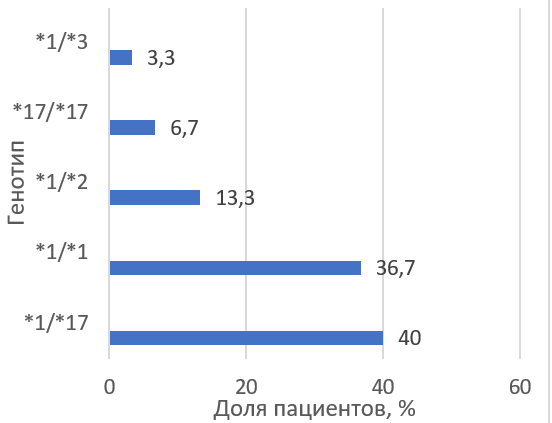 | 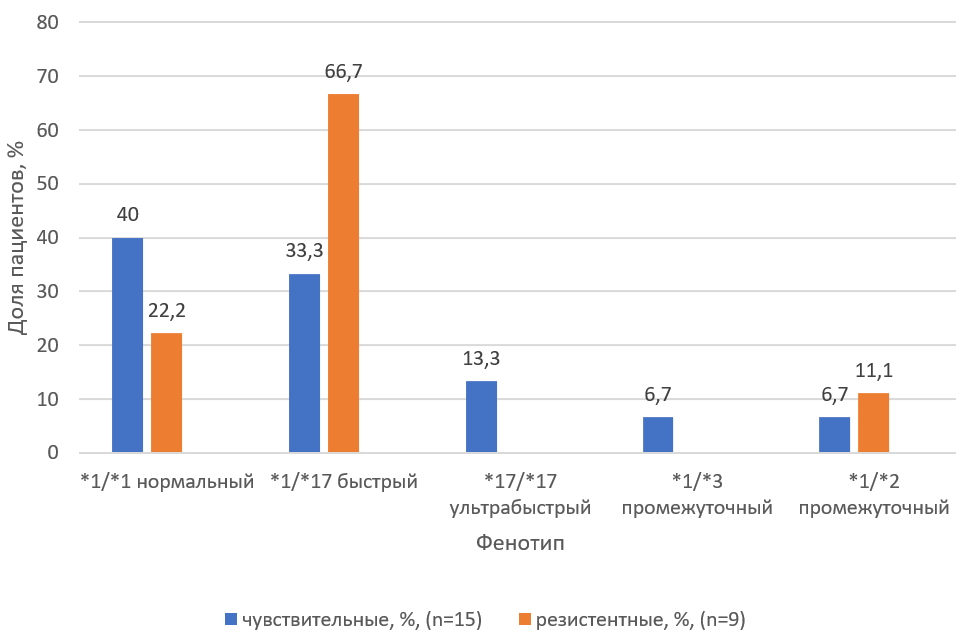 |
| A. Genotypes of Chuvash patients with ACS (n=30) | B. Clopidogrel metabolism phenotypes and laboratory response to antiplatelet therapy in Chuvash patients with ACS (n=30) |
Fig. 1. Results of pharmacogenetic testing and laboratory assessment of platelet aggregation in Chuvash patients with ACS
Genotypes were transformed into metabolism phenotypes according to the CPIC and DPWG consensus: 46.6% of patients were classified as "rapid metabolizers," 16.4% as "intermediate metabolizers," 37% as "normal metabolizers," with no "poor metabolizers" identified. Notably, among "ultrarapid metabolizers," all patients were sensitive to antiplatelet agents on laboratory assessment of platelet function (Fig. 1B). It should be noted that with other phenotypic manifestations, both sensitive and resistant individuals were observed. The predominant proportion of resistant patients had the *1/*17 genotype, phenotypically corresponding to rapid metabolism.
A prospective study was conducted using genotyping of CYP2C19 and ABCB1 genes, recommended for personalization of antiplatelet therapy with P2Y12 receptor inhibitors, which included 216 ethnically homogeneous patients (Chuvash by self-identification in two or more generations) with CVD (see Table 1). The median age of patients was 66.5 years [Q1–Q3 61–72], among whom MI was recorded in half of the study participants (50%): first-onset MI — 36.6% of patients, recurrent MI — in 13.4%. It should be immediately noted that the analysis of pharmacogenotyping results in Chuvash patients with CVD revealed some peculiarities: a rather high prevalence of CYP2C19*17 carriage, the heterozygous CT variant of which was associated with recurrent MI, as well as a very high polymorphism of ABCB1 3435C>T, which did not show an independent statistical association with clinical outcomes. Regarding CYP2C19*2 (681G>A) and CYP2C19*3 (636G>A) polymorphisms associated with loss of enzyme function, their frequency in the Chuvash population proved relatively low, and no association of these polymorphisms with recurrent MI was found.
The frequency of the minor T allele of CYP2C19*17 among Chuvash patients was 28.7%, significantly exceeding figures for Asian populations (0.96–13.7%) and falling within the range characteristic of Europeans (20–42%) and Caucasians (21–34%) [3, 12, 13]. Heterozygous CT genotype was identified in 44.4% of examined individuals (CT — 44.4% vs. TT — 6.5%), carriers of which more frequently had recurrent MI both in the overall cohort of Chuvash patients with CVD (n=216, p=0.049; CC 8.5% vs. CT 19.8%) and in the ACS subgroup (n=142, p=0.037; CC 12.9% vs. CT 30.2%, p~CC–CT~=0.044). It is important to emphasize that the distribution of CYP2C19*17 genotypes in both the overall cohort (χ²=1.59, p=0.21) and the ACS subgroup (χ²=1.10, p=0.29) conformed to Hardy–Weinberg equilibrium, confirming the representativeness and genetic homogeneity of the studied Chuvash cohort.
Contemporary studies confirm the significant role of CYP2C19 in shaping the response to antiplatelet therapy with P2Y12 receptor inhibitors. It is well established that carriage of CYP2C19*17 (rs12248560, –806C>T) is associated with increased transcription and activity of the CYP2C19 isoenzyme, enhancing the biotransformation of clopidogrel into its active metabolite and inhibition of platelet P2Y12 receptors. Numerous randomized clinical trials and their meta-analyses confirm that gain-of-function of CYP2C19 is associated with improved antiplatelet effect, although it is accompanied by increased hemorrhagic risk [4]. However, in the present study, we did not observe a single case of bleeding; on the contrary, a statistically significant association of carriage of the minor allele in the heterozygous CT variant of CYP2C19*17 with increased frequency of recurrent MI was identified, and in pairwise comparison, CT genotype carriers had significantly more frequent recurrent MI compared to CC carriers (p=0.044). This result, at first glance, contradicts theoretical expectations and requires deeper analysis and discussion of other factors.
It can be hypothesized that nongenetic factors, such as drug–drug interactions, may have played a certain role in our study, potentially leading to the phenomenon of phenoconversion — a discrepancy between the genotypically predicted and actually observed clopidogrel metabolism phenotype. Notably, in the present study, all Chuvash patients with ACS on DAPT simultaneously received omeprazole therapy for prevention of gastrointestinal bleeding. Omeprazole is a CYP2C19 inhibitor and can clinically significantly reduce enzyme activity. However, despite FDA warnings and CPIC recommendations, this proton pump inhibitor is standardly prescribed for GI bleeding prophylaxis during DAPT due to pharmacoeconomic benefits. Replacing omeprazole with pantoprazole/rabeprazole (weak CYP2C19 inhibitors) could potentially optimize DAPT without compromising GI prophylaxis.
It is known that omeprazole reduces the area under the pharmacokinetic curve of clopidogrel's active metabolite by 40–50% in rapid metabolizers [4, 7–10], which could have, in our study, altered the phenotype toward slower metabolism in ACS patients with the *1/*17 genotype (genotypically predicted rapid metabolizer phenotype). Thus, in laboratory assessment of ADP-induced platelet aggregation, the largest proportion of antiplatelet-resistant patients was observed precisely among heterozygotes (see Fig. 1), whereas among TT homozygotes (ultrarapid metabolizer phenotype), not a single case of resistance was recorded. Theoretically, this can be explained by the fact that with the initially very high enzyme activity, sufficient metabolism is preserved upon omeprazole inhibition to ensure the antiplatelet effect of clopidogrel.
An additional factor contributing to phenoconversion may be systemic inflammation during ACS. Elevated levels of proinflammatory cytokines (e.g., interleukin-6) can suppress the expression of hepatic microsomal enzymes [21].
ABCB1 C3435T was characterized by high polymorphism in Chuvash patients (TT 35.6%, CT 50.0%, minor T allele frequency — 60.6%). These data indicate higher prevalence compared to Europeans and Asians, where the frequency is approximately 50% [3, 13]. It is well known that P-glycoprotein limits clopidogrel absorption in the intestine by pumping it back into the intestinal lumen. However, the ABCB1 3435C>T polymorphism, according to literature data, is associated with reduced transporter activity, which theoretically should lead to increased clopidogrel bioavailability. However, meta-analyses show that the homozygous TT genotype is associated with a significantly increased risk of recurrent cardiovascular events [4], but in our study, the frequency of recurrent MI depending on the ABCB1 polymorphism did not show statistically significant differences.
In the Chuvash patients we genotyped, there was simultaneously a high frequency of carriage of both CYP2C19*17 and ABCB1 3435C>T. Phenotypically, they manifest as opposing in terms of clopidogrel antiplatelet effect realization. The high frequency of carriage of polymorphisms in Chuvash patients makes ABCB1 another potential factor of phenoconversion when co-carried with CYP2C19*17.
Results from studies on associations with other genotypes that may distort the phenotype for *17 carriers are characterized by heterogeneity. Studies of combinations of CYP2C19*17 and ABCB1 did not reveal an additive effect on platelet reactivity. In a cohort of 101 Chinese patients, CYP2C19*17 was rare (0.99%) and did not affect ADP-induced inhibition. Similarly, in 500 Chinese patients with ACS, neither CYP2C19*17 nor ABCB1 correlated with residual platelet reactivity (ADP aggregation >50%) [5]. The absence of interaction (CYP2C19*17 + ABCB1) is also confirmed in Asian populations, but extrapolation to Europeans is limited.
Literature data on the combination of ABCB1 C3435T (TT genotype), CYP2C19*17 with omeprazole use are also lacking. Our study indirectly demonstrates that with the simultaneous combination of three factors (carriage of 2 polymorphic genes + omeprazole prescription), neutralization of clopidogrel's antiplatelet effect may occur [7–9, 16, 17], apparently due to reduced systemic exposure of the thiol metabolite, manifesting as high residual platelet reactivity and risks of cardiovascular events. Patients with such a combined genotype should preferably be recommended an alternative antiplatelet agent to clopidogrel — ticagrelor, which provides aggregation inhibition independent of polymorphisms [2, 5, 6–8, 10, 19], as well as use of pantoprazole/rabeprazole to eliminate drug–drug interactions.
Thus, the results obtained indicate that in Chuvash patients with ACS, one should not rely solely on the genotype (especially in the heterozygous variant) of CYP2C19*17 as a marker of good response to clopidogrel, since the high frequency of this allele in the population, in combination with other genetic and nongenetic factors, carries risks of phenoconversion. Thus, omeprazole use in CYP2C19*17 carriers, especially in the heterozygous state, requires caution. The preferred proton pump inhibitor in these patients may be pantoprazole, which does not inhibit CYP2C19, thereby preserving genetically determined rapid metabolism. Apparently, genotyping for CYP2C19*17 without considering phenoconverting factors has limited predictive value for individualization of antiplatelet therapy in Chuvash patients.
The power of the present study should be considered sufficient. Although only 216 patients participated, the pharmacogenetic testing results conformed to expected Hardy–Weinberg distributions, indicating sample representativeness and the validity of extrapolating conclusions to the population level.
Study limitations include the absence of active metabolite concentration measurements, which does not allow definitive confirmation of the phenoconversion hypothesis; prospective studies with larger samples, stratified by different proton pump inhibitors, with assessment of clopidogrel active metabolite plasma concentrations, and analysis of the combined influence of CYP2C19*17 and ABCB1 3435T on clinical outcomes are required for confirmation.
Among Chuvash patients with CVD, the following minor allele frequencies were established: ABCB1 (3435C>T, rs1045642) — 60.6%, CYP2C19*17 (–806C>T, rs12248560) — 28.7%, CYP2C19*2 (681G>A, rs4986893) — 9.05%, CYP2C19*3 (636G>A) — 1.85%.
An association of the minor T allele in heterozygous carriage of CYP2C19*17 with recurrent MI was identified both in the overall CVD cohort (n=216, p=0.049; CC 8.5% vs. CT 19.8%) and in the ACS subgroup (n=142, p=0.037; CC 12.9% vs. CT 30.2%, p~CC–CT~=0.044).
In laboratory assessment of ADP-induced platelet aggregation in Chuvash patients with ACS, the predominant proportion of antiplatelet-resistant patients was among carriers of the minor T allele in the heterozygous state of CYP2C19*17.
1. Lewis JP, Stephens SH, Horenstein RB, et al. The CYP2C19*17 variant is not independently associated with clopidogrel response. J Thromb Haemost. 2013 Sep;11(9):1640-6. doi: 10.1111/jth.12342.
2. Hulot JS, Bura A, Villard E, et al. Cytochrome P450 2C19 loss-of-function polymorphism is a major determinant of clopidogrel responsiveness in healthy subjects. Blood. 2006 Oct 1;108(7): 2244-7. doi: 10.1182/blood-2006-04-013052.
3. Dello Russo C, Frater I, Kuruvilla R, et al. CYP2C19 genotype testing for clopidogrel: A guideline developed by the UK Centre of Excellence in Regulatory Science and Innovation in Pharmacogenomics (CERSI-PGx). Br J Clin Pharmacol. 2026 Feb;92(2):329-347. doi: 10.1002/bcp.70370.
4. Huang B, Cui DJ, Ren Y, et al. Effect of cytochrome P450 2C19*17 allelic variant on cardiovascular and cerebrovascular outcomes in clopidogrel-treated patients: A systematic review and meta-analysis. J Res Med Sci. 2017 Sep 26;22:109. doi: 10.4103/jrms.JRMS_590_16.
5. Zhuo ZL, Xian HP, Long Y, et al. Association between CYP2C19 and ABCB1 polymorphisms and clopidogrel resistance in clopidogrel-treated Chinese patients. Anatol J Cardiol. 2018 Feb;19(2):123-129. doi: 10.14744/AnatolJCardiol.2017.8097.
6. Kitaeva EYu, Shprakh VV, Mirzaev KB, et al. Frequency of CYP2C19 and ABCB1 genes polymorphisms, associated with the change, caused by clopidogrel antiagregant among the Russians and the Buryats. Siberian Medical Review. 2018;(3):43-50. (In Russ.).
7. Mirzaev K.B., Sychev D.A., Andreev D.A. Ethnic characteristics of the CYP2C19 gene polymorphism associated with impaired response to clopidogrel in the Russian Federation. Molecular Medicine. 2014;1:13-21. (In Russ.).
8. Li Y, Tang HL, Hu YF, Xie HG. The gain-of-function variant allele CYP2C19*17: a double-edged sword between thrombosis and bleeding in clopidogrel-treated patients. J Thromb Haemost. 2012 Feb;10(2):199-206. doi: 10.1111/j.1538-7836.2011.04570.x.
9. Sibbing D, Koch W, Gebhard D, et al. Cytochrome 2C19*17 allelic variant, platelet aggregation, bleeding events, and stent thrombosis in clopidogrel-treated patients with coronary stent placement. Circulation. 2010 Feb 2;121(4):512-8. doi: 10.1161/CIRCULATIONAHA.109.885194.
10. Applied Pharmacogenetics: monograph / [Sychev D. A., Abdullaev Sh. P., Ametov A. S. [et al.]]; edited by D. A. Sychev. - Moscow: Triada, 2021. - 494 p.: ill.: 25 cm; ISBN 978-5-94789-982-5. (In Russ.).
11. All-Russian Population Census 2020. Results of the All-Russian Population Census 2020. Volume 5: Ethnic Composition and Language Proficiency. https://rosstat.gov.ru/vpn/2020/Tom5_Nacionalnyj_sostav_i_vladenie_yazykami
12. Georgieva KS, Pavlova SI, Zhuchkova SM. Resistance to antiplatelets in patients with acute coronary event: pharmacogenetic aspects and drug interactions. Experimental and Clinical Pharmacology. 2024;87(2):20–26. (In Russ.).
13. Makeeva O, Stepanov V, Puzyrev V, et al. Global pharmacogenetics:geneticsubstructureofEurasian populations and its effect on variants of drug-metabolizing enzymes. Pharmacogenomics. 2008 Jul;9(7):847-68. doi: 10.2217/14622416.9.7.847.
14. Vasilyev FF, Danilova DA, Kaimonov VS, et al. Frequency distribution of polymorphisms of CYP2C19, CYP2C9, VKORC1 and SLCO1B1 genes in the Yakut population. Res Pharm Sci. 2016 May-Jun;11(3):259-64.
15. Shuev G.N., Sychev D.A., Suleymanov S.Sh., et al. Comparison of CYP2C9, CYP2C19, CYP2D6, ABCB1, SLCO1B1 gene polymorphism frequency in Russian and Nanai populations. Pharmacogenetics and Pharmacogenomics. 2016;(2):12-18. (In Russ.).
16. Lee CR, Luzum JA, Sangkuhl K, et al. Clinical Pharmacogenetics Implementation Consortium Guideline for CYP2C19 Genotype and Clopidogrel Therapy: 2022 Update. Clin Pharmacol Ther. 2022 Nov;112(5):959-967. doi: 10.1002/cpt.2526.
17. Pratt VM, Cavallari LH, Fulmer ML, et al. CYP3A4 and CYP3A5 Genotyping Recommendations: A Joint Consensus Recommendation of the Association for Molecular Pathology, Clinical Pharmacogenetics Implementation Consortium, College of American Pathologists, Dutch Pharmacogenetics Working Group of the Royal Dutch Pharmacists Association, European Society for Pharmacogenomics and Personalized Therapy, and Pharmacogenomics Knowledgebase. J Mol Diagn. 2023 Sep;25(9):619-629. doi: 10.1016/j.jmoldx.2023.06.008.
18. Gross L, Trenk D, Jacobshagen C, et al. Genotype-Phenotype Association and Impact on Outcomes following Guided De-Escalation of Anti-Platelet Treatment in Acute Coronary Syndrome Patients: The TROPICAL-ACS Genotyping Substudy. Thromb Haemost. 2018 Sep;118(9):1656- 1667. doi: 10.1055/s-0038-1667337.
19. Markova A.S., Mirzaev K. B., Sychev D.A., et al. The role of CYP2C19 gene nucleotide sequence variants in assessing response to P2Y12 receptor inhibitor antiplatelet therapy in old patients with acute coronary syndrome. Rational Pharmacotherapy in Cardiology. 2025;21(5):441-448. (In Russ.).
20. Vorobyov A.S., Lifshits G.I., Zelenskaya E.M., et al. Clinically significant CYP2C19 genotypes in patients with myocardial infarction in the northern region of Russia. Russian Journal of Cardiology. 2023;28(10):5533. (In Russ.).
21. Lenoir C, Niederer A, Rollason V, et al. Prediction of cytochromes P450 3A and 2C19 modulation by both inflammation and drug interactions using physiologically based pharmacokinetics. CPT Pharmacometrics Syst Pharmacol. 2022 Jan;11(1):30-43. doi: 10.1002/psp4.12730.
Ksenia S. Georgieva — Senior Lecturer, Department of Pharmacology, Clinical Pharmacology, and Biochemistry
Cheboksary
Svetlana I. Pavlova — Dr. Sci. (Med.), Professor, Head of the Department of Pharmacology, Clinical Pharmacology, and Biochemistry
Cheboksary
Georgieva K.S., Pavlova S.I. CYP2C19 and ABCB1 polymorphisms in patients of Chuvash ethnic group: assessment of clopidogrel resistance and associations with recurrent myocardial infarction. Pharmacogenetics and Pharmacogenomics. 2026;(2):95-105. (In Russ.) https://doi.org/10.37489/2588-0527-0014. EDN: OSWOLZ
НАШИ КНИГИ



Другие журналы
"Издательства ОКИ"




ПАРТНЕРЫ


 Email this article (Login required)
Email the author (Login required)
Email this article (Login required)
Email the author (Login required)  Post a Comment (Login required)
121357, Moscow, st. Vatutina, 4, building 2, apt. 22
LLC "Izdatelstvo OKI"
Tel. + 7 (916) 986-04-65
Email: eva88@list.ru